The problem no one quantifies — and the math that proves you’re overpaying.
Why Most Amazon Sellers Overpay for Fulfillment — Part 1: The Hidden Costs Nobody Talks About
|
February 2026
|
7 min read
You negotiated your pick-and-pack rate down to $2.50. You compared three 3PLs. You chose the cheapest one. And you’re still overpaying — by an average of $1.85 per order.
The Core Problem: Amazon sellers evaluate fulfillment costs by comparing a single line item — the pick-and-pack fee — while ignoring the 6 to 12 additional cost layers that make up 40-65% of their actual monthly spend.
The Amazon Fulfillment Cost Iceberg
When most sellers shop for a 3PL, the conversation starts and ends with one question: “What’s your pick-and-pack rate?” It’s the shipping industry’s version of judging a restaurant by its menu prices without checking for service charges, gratuity, and parking.
According to the Fulfillment by Amazon Revenue Calculator and third-party logistics industry benchmarks, the average Amazon seller shipping 500 orders per month is exposed to between 8 and 18 distinct cost categories — most of which never appear in the initial 3PL quote.
Based on industry average 3PL pricing at 500 monthly orders with standard storage and returns processing
The 5 Cost Layers Most 3PLs Don’t Show You Upfront
We analyzed pricing from over a dozen fulfillment providers targeting Amazon sellers in the 500–2,500 monthly order range. Here’s what we found hiding below the surface:
Layer 1: Poly Envelopes & Packaging Materials
Every order needs packaging. Most 3PLs quote pick-and-pack as if the package materializes from thin air. The reality: packaging materials add $0.15 to $0.35 per order depending on the item profile.
What competitors charge: Standard poly envelopes are billed at $0.15–$0.25 per unit on top of the pick-and-pack fee. For a seller at 500 orders/month, that’s $75–$125 in monthly packaging fees that wasn’t in the original quote.
Layer 2: Storage Fee Escalation
The initial quote says “$25/pallet/month” — sounds reasonable. But dig into the fine print and you’ll find most 3PLs use a flat rate regardless of volume. There’s no incentive structure rewarding growth.
| Volume Tier | Industry Standard | Volume-Scaled Model | Monthly Difference (2 pallets) |
|---|---|---|---|
| 0–500 orders | $25–$40/pallet | $25/pallet | $0–$30 |
| 501–2,500 | $25–$40/pallet | $25/pallet | $0–$30 |
| 5,001–7,500 | $25–$40/pallet | $12/pallet | $26–$56 |
| 7,501–10,000 | $25–$40/pallet | FREE | $50–$80 |
Comparison: flat-rate industry storage vs. volume-dependent pallet pricing model
At scale, the difference is dramatic. A seller processing 8,000 orders/month with 4 standard pallets saves $100–$160/month on storage alone — if their 3PL actually offers volume-based scaling. Most don’t.
Layer 3: The Returns Processing Trap
Returns are inevitable in e-commerce — averaging 5–8% of orders depending on the product category. Yet most 3PL quotes exclude returns processing entirely, treating it as an “add-on.”
For a seller at 500 orders/month with a 5% return rate, that’s 25 returns. At industry-average return processing rates of $1.50–$3.00 per unit plus $2.00–$5.00 for return labeling, you’re looking at $87–$200 in monthly costs that never appeared in the original quote.
Layer 4: Multi-Item Order Markups
Your average order contains 1.5 items? That extra half-item per order triggers an “extra pick” charge on every multi-item order. Industry rates for the additional pick range from $0.35 to $1.00 per item.
| Avg Items/Order | Monthly Orders | Extra Picks/Month | Extra Cost @ $0.50 | Extra Cost @ $0.35 |
|---|---|---|---|---|
| 1.5 | 500 | 250 | $125.00 | $87.50 |
| 1.5 | 2,500 | 1,250 | $625.00 | $437.50 |
| 2.0 | 5,000 | 5,000 | $2,500.00 | $1,750.00 |
Impact of extra pick fees across volume tiers — the $0.15/item difference compounds quickly
Layer 5: Shipping Rate Opacity
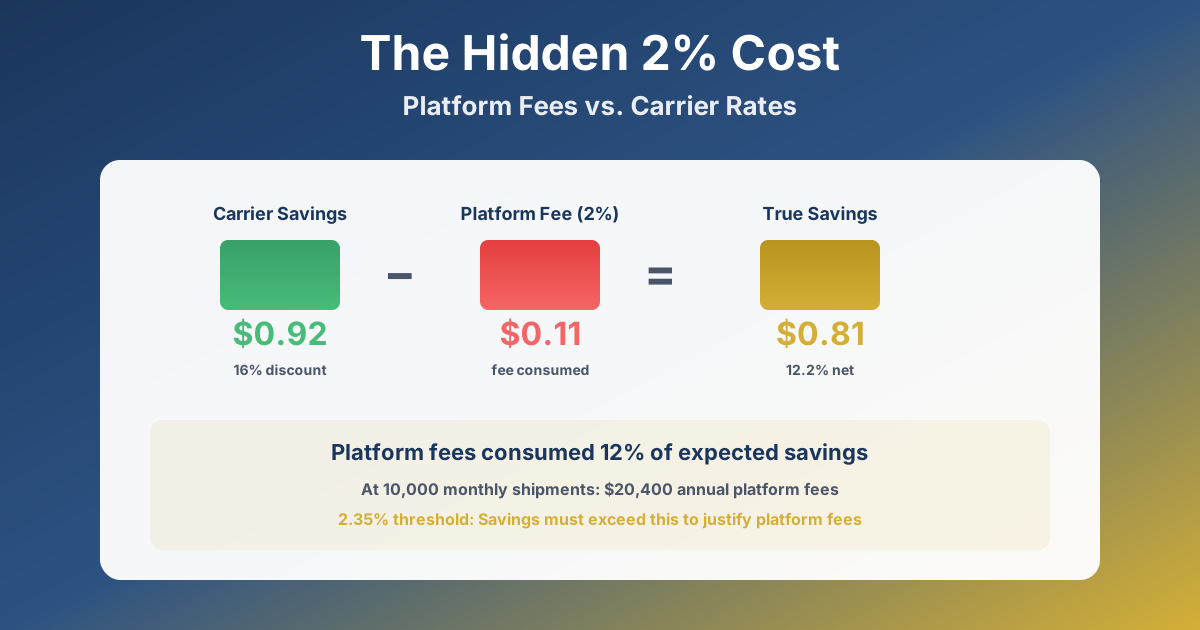
This is the biggest hidden cost of all. Most sellers evaluate 3PLs based on fulfillment fees while accepting whatever shipping rate the provider offers. Our analysis of contracted carrier rates reveals that sellers using retail USPS and UPS rates overpay by 25–49% compared to volume-contracted DHL and USPS rates.
The shipping math at 500 orders/month:
That’s nearly $10,000/year in shipping costs alone — a savings larger than most sellers’ entire fulfillment budget difference between 3PLs.
The Real Cost Comparison: What 500 Orders/Month Actually Looks Like
Let’s build the full picture. Here’s a realistic monthly cost breakdown for an Amazon seller at 500 orders/month, 1.5 items per order, with standard storage and 5% returns:
| Cost Category | Typical 3PL Quote | Actual All-In Cost | What’s Hidden |
|---|---|---|---|
| Pick & Pack (500 orders) | $1,200.00 | $1,287.50 | Extra pick fees |
| Poly Envelopes | Not quoted | $100.00 | $0.20/unit charged separately |
| Storage (2 pallets + bins) | $50.00 | $59.10 | Bin storage not in headline rate |
| Returns Processing | Not quoted | $87.50 | $1.50/unit + $2.00 labeling |
| Shipping (retail rates) | ~$2,750 | ~$2,750 | No contracted discount |
| TOTAL | $4,000 | $4,284 | $284/mo hidden |
Typical 3PL quoted costs vs. actual monthly spend — based on 500 orders, 1.5 items/order, 12oz avg weight, 5% returns
That $284 monthly gap — $3,408 annually — comes before we factor in the shipping rate differential. When you add contracted carrier savings, the total overpayment often exceeds $12,000 per year for a 500-order seller.
“The fulfillment industry has trained sellers to compare pick-and-pack rates the way airlines trained travelers to compare base fares — ignoring baggage fees, seat selection, and change fees that often double the ticket price.”
— Multichannel Merchant, 2025 3PL Buyer’s Guide
Why This Problem Gets Worse With Amazon FBA Prep
If you’re selling on Amazon and using a 3PL for FBA preparation, the hidden cost problem multiplies. FBA prep involves up to 18 distinct service steps — from receiving pallets and cartons, through FNSKU labeling, poly bagging, bubble wrapping, compliance labeling, kitting, carton prep, palletizing, and outbound handling.
Most 3PLs bundle these into a vague “FBA prep fee” — typically $2.00–$5.00 per unit — without itemizing what’s included. The result: sellers either overpay for services they don’t use, or get hit with surprise charges when their actual prep requirements emerge.
The FBA prep opacity problem: A seller sending 100 units to Amazon FBA through a typical 3PL sees a “prep fee” on their invoice. What they don’t see is a line-by-line breakdown of receiving, labeling, wrapping, carton prep, palletizing, storage, and outbound charges — each with its own rate and volume.
The Question You Should Be Asking
Stop asking “What’s your pick-and-pack rate?”
Start asking: “Show me every cost category that will appear on my monthly invoice — with unit rates, volumes, and totals.”
If a 3PL can’t produce a detailed, itemized cost breakdown covering pick & pack, storage (by pallet type and bin size), returns, value-added services, FBA prep (all 18 steps), and shipping — with transparent volume-tier pricing that rewards growth — they’re not transparent. They’re hoping you won’t do the math.
Coming in Part 2: The Solution
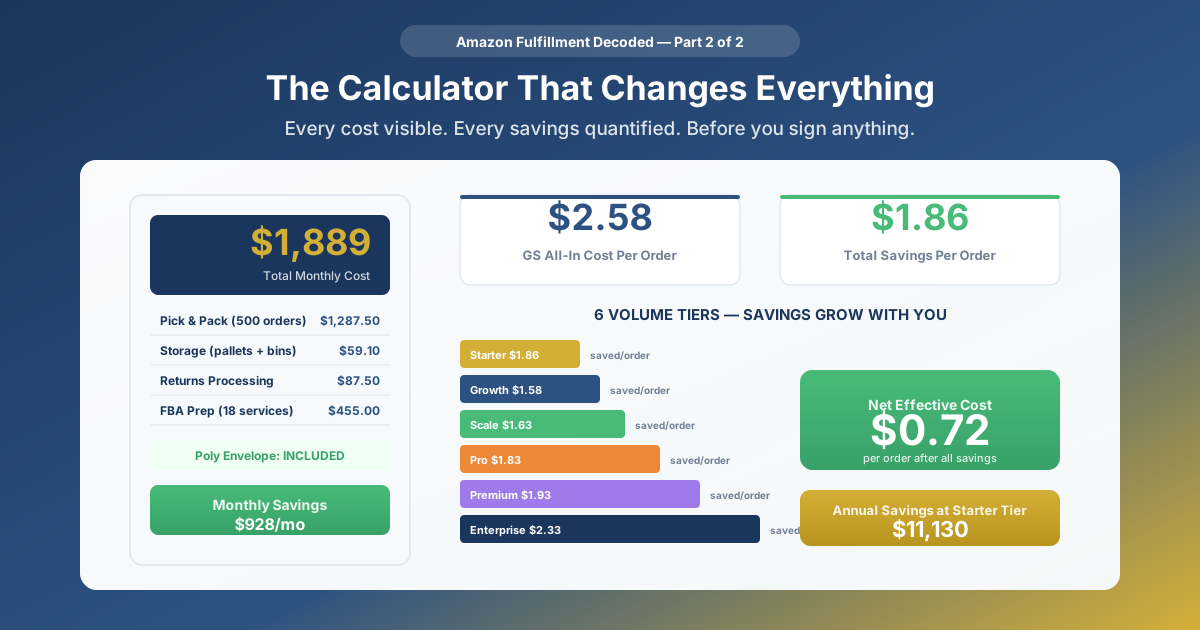
We built a tool that eliminates fulfillment cost guesswork entirely. In Part 2, we reveal the Gold Standard Quote Calculator — a dynamic pricing engine that itemizes every cost, applies volume-tier discounts automatically, and shows you exactly what you’ll pay before you ship a single unit.
We’ll walk through a real $1,889/month cost breakdown, line by line — including $927 in monthly savings most sellers leave on the table.
Part 2 drops next week. Don’t miss it.
References
- Jungle Scout (2025). “State of the Amazon Seller Report — 2025 Edition.” junglescout.com
- National Retail Federation (2025). “Consumer Returns in the Retail Industry — 2025 Report.” nrf.com
- Shipware (2025). “Parcel Shipping Index: Small Package Market Analysis 2025.” shipware.com
- Multichannel Merchant (2025). “3PL Buyer’s Guide: Total Cost of Fulfillment.” multichannelmerchant.com
- Digital Commerce 360 (2025). “E-commerce Fulfillment Cost Benchmarks.” digitalcommerce360.com